Physical Address
304 North Cardinal St.
Dorchester Center, MA 02124
Physical Address
304 North Cardinal St.
Dorchester Center, MA 02124
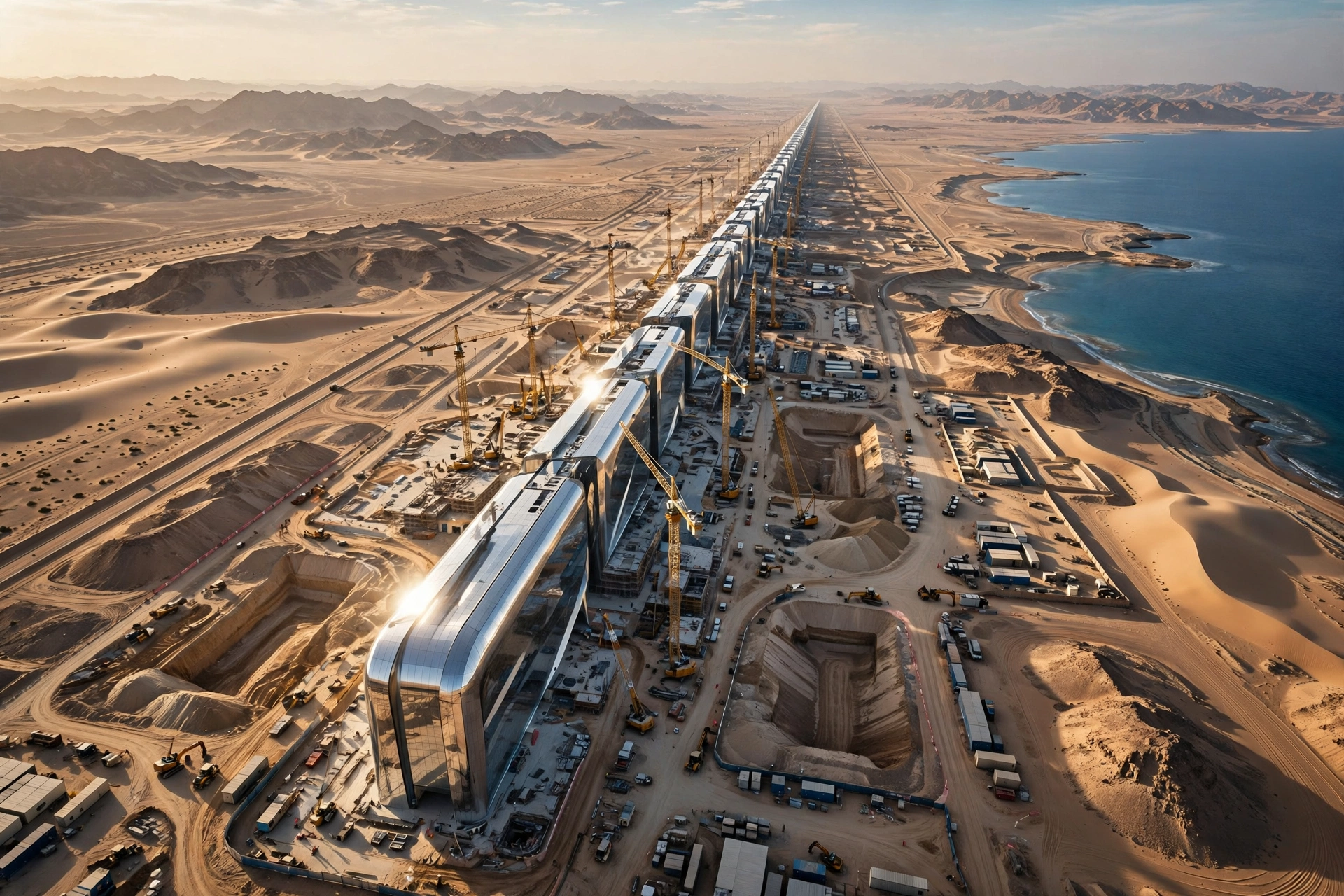
NEOM is the most ambitious — and most debated — construction project on the planet. Announced in 2017 by Crown Prince Mohammed bin Salman as the centrepiece of Saudi Arabia’s Vision 2030, it’s a planned $500 billion region in the country’s northwest, on the Red Sea coast near the Gulf of Aqaba. The name blends the Greek “neo” (new) with “mustaqbal,” the Arabic word for future. NEOM isn’t a single city but a collection of regions and developments — most famously The Line, a mirrored linear city originally planned to stretch 170 kilometres. As of late 2026, the project’s reality looks very different from its original renders, and understanding that gap is key to understanding NEOM.
NEOM comprises several distinct developments:
This is where the story gets complicated. By late 2026, reporting indicates that The Line’s construction — which involved massive excavation and foundation work — was paused around September 2025 pending a strategic review by Saudi Arabia’s Public Investment Fund (PIF), which owns NEOM. Before the pause, roughly 2.4 kilometres of foundation work had been completed out of the planned 170 — about 1.4% of the total length. The mirrored cladding that defined the renders exists only in images so far.
In 2026, NEOM terminated several major contracts tied to The Line and Trojena — reportedly worth a combined $5 billion or more — and the PIF governor stated publicly that completing The Line by 2030 was “good to have, but not a must,” describing it as no longer the top priority. Population targets have been repeatedly cut: from 1.5 million residents by 2030, to 300,000, and reportedly as low as 100,000 in the near term. An internal audit leaked in 2025 reportedly put the cost of finishing The Line to its original specification at a staggering figure in the trillions, with completion stretching decades out. The PIF recorded an $8 billion write-down in 2025, with NEOM the largest contributor.
To be fair, PIF leadership insists no projects have been formally cancelled and that NEOM is being rescoped rather than abandoned. Sindalah is open, enabling works continue, and Saudi Arabia still presents NEOM as central to its long-term diversification. But the era of “170 km by 2030” is over.
Saudi Arabia will host the 2034 FIFA World Cup — the first single-nation host of the expanded 48-team format — and NEOM was supposed to play a starring role. The planned NEOM Stadium, a 46,000-seat arena perched 350 metres above the ground inside The Line, was one of 15 proposed venues. In October 2026, Reuters reported that the stadium plans had been shelved indefinitely amid the delays and downscaling, with the construction database MEED listing it as on hold. Saudi authorities haven’t publicly removed it from the World Cup programme, but no replacement venue has been announced either. The episode captures NEOM’s current status: still officially alive, but visibly shrinking.
No honest explainer can skip the difficult parts:
Even scaled back, NEOM matters enormously — for Saudi Arabia’s economy, for the Gulf’s development model, and as a case study in the limits of top-down megaprojects. The Kingdom has been shifting investment toward projects with quicker returns (tourism destinations like the Red Sea Project, which is further along; sports and entertainment assets), while NEOM is redesigned into something deliverable. Whether the eventual result is a modest tech-and-tourism zone or something closer to the original vision, the next few years will decide.
Not really, not yet. Sindalah island is open to luxury travellers, and there are occasional media and investor visits to the construction areas. For most travellers, the accessible face of Saudi Arabia’s transformation is elsewhere for now — AlUla, Jeddah, Riyadh. Start with our Saudi tourist visa guide and Gulf News coverage, and watch this space: NEOM’s story is far from over.